
Expense policy and VAT: what a policy must contain
An expense policy defines which costs the company reimburses, up to what amount and how they are claimed. It creates clarity for everyone and is the basis for flat-rate expenses. If you store your policy digitally, every expense report is automatically checked against it.
Correct as of October 2026. This guide provides general information and does not replace legal advice.
What an expense policy is for
Under the Code of Obligations (Article 327a), the employer reimburses all costs necessarily incurred at work. An expense policy turns this into clear rules: what is paid, up to what amount, with which receipt?
That way employees know where they stand, and approval is faster.
What belongs in the policy
- Scope: who the rules apply to
- Expense types: travel, meals, accommodation, entertainment
- Rates and maximum amounts per expense type
- Receipt requirements and claim deadlines
- Who approves expenses
- Rules for private vehicles and credit cards
- Notes on value-added tax
Flat rates
Flat-rate expenses simplify claims because not every single cost needs its own receipt. They must be agreed in writing. For the tax treatment of flat-rate expenses, the cantonal tax authority will approve an expense policy on request, which provides legal certainty.
Flat rates in the policy should match actual costs and be easy to understand.
VAT on expenses
Companies subject to VAT can generally deduct input tax on expenses with a valid receipt. The receipt needs the usual invoice details for this, including the supplier's VAT number. For flat-rate expenses, input tax deduction is generally not available.
Your fiduciary firm or the Federal Tax Administration can check the details. A clean receipt makes the deduction easy.
Have your policy checked digitally
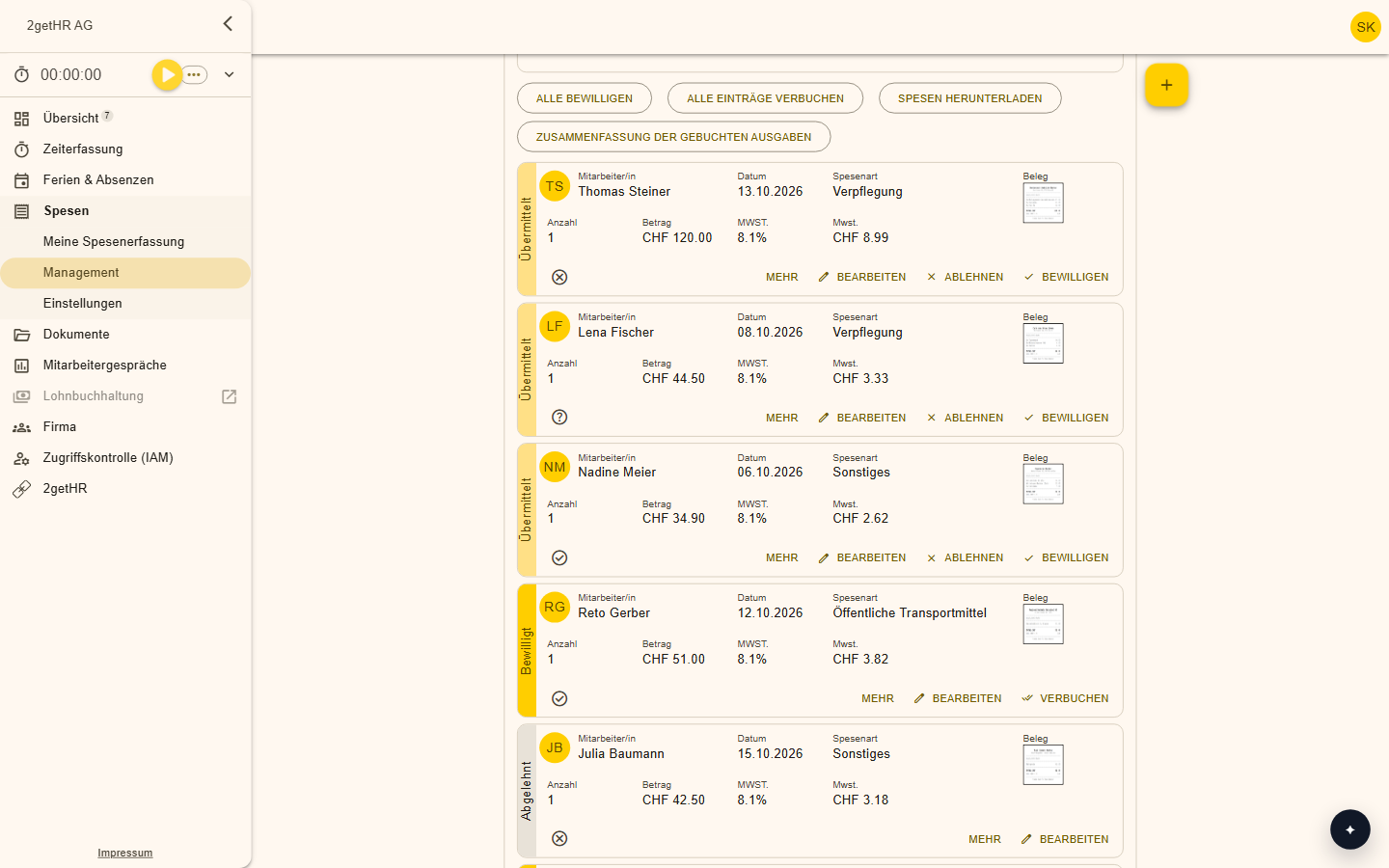
With 2getHR you upload your expense policy. Every expense report submitted is then automatically checked against it, and deviations become visible. This makes approvals go faster.
Learn more on the AI expense check page and under digital expenses.
Frequently asked questions
Do I need an expense policy?
The law requires reimbursement of necessary costs. A policy makes the rules clear for everyone and is the basis for flat rates.
Does the policy have to be approved by the tax authority?
That is not necessary in every case, but it is recommended for flat-rate expenses because it provides legal certainty.
Make your team's everyday work easier
Try 2getHR free for 30 days. We're happy to help you get started, in the webinar or in training.