
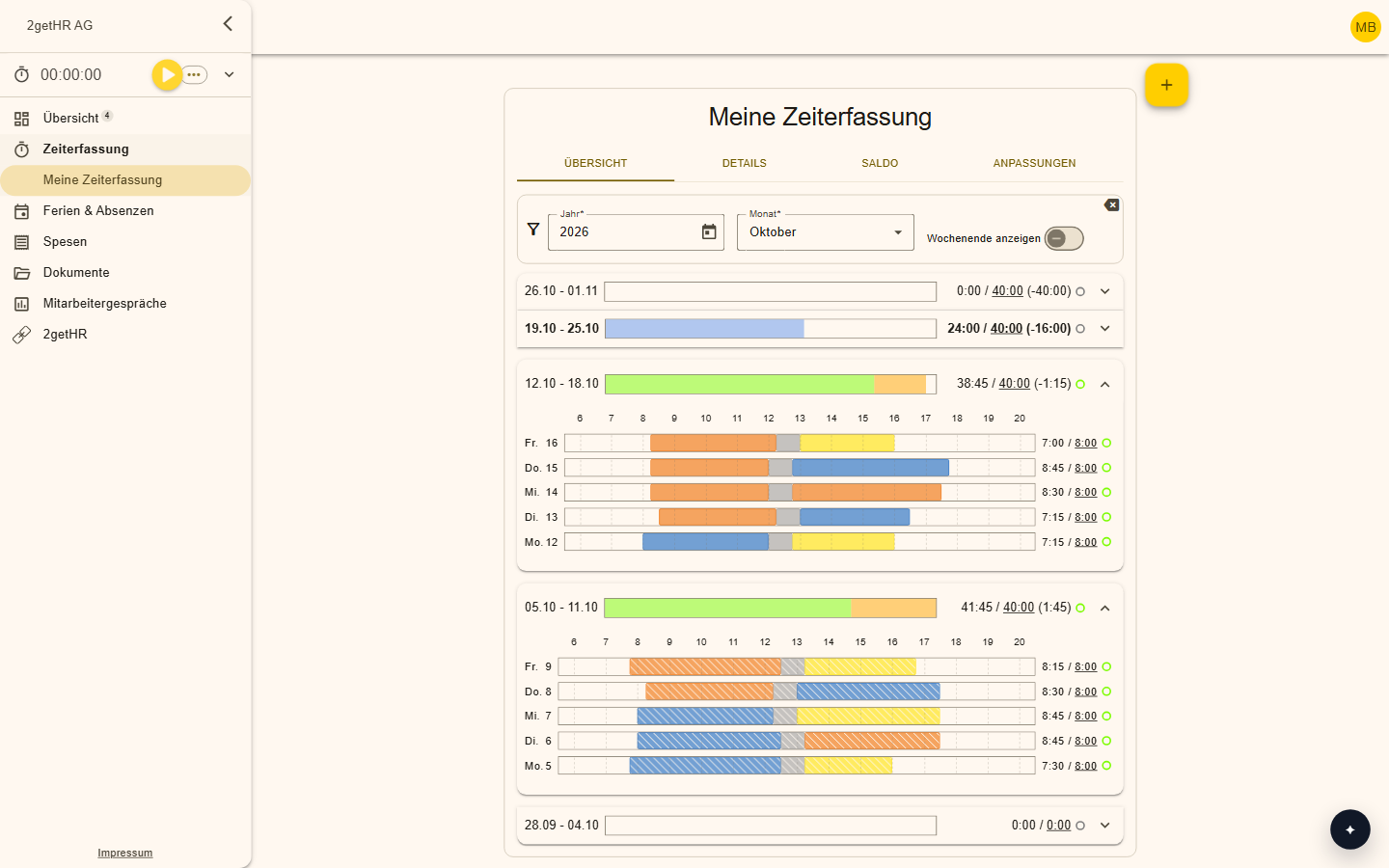
Time tracking in Switzerland: law, obligation and practice
In Switzerland, employers subject to the Labour Act (ArG) must record the working time of their employees. This includes daily and weekly working time, breaks of at least 30 minutes, and night and Sunday work. Under certain conditions, simplified recording is sufficient, and in rare cases it can be waived entirely.
Correct as of October 2026. This guide provides general information and does not replace legal advice.
Who records working time
The Labour Act (ArG) and its Ordinance 1 (ArGV 1, Article 73) require the employer to keep records of working hours. This applies to companies subject to the Labour Act, which covers most Swiss SMEs.
The employer can hand over the daily entry to employees, and in most cases they record their own time. The employer nevertheless remains responsible.
What is recorded
The records cover the daily and weekly working time actually worked, including compensatory time and overtime, the timing of breaks of at least half an hour, and night and Sunday work including compensation.
Simplified recording
Employees who can set a substantial part of their working time themselves may use simplified time recording (ArGV 1, Article 73b). In that case, only the total daily working time is recorded, without start, end and breaks.
Simplified recording requires an agreement. It is usually regulated in a collective labour agreement, and in smaller companies with fewer than 50 employees also directly with the employees.
Waiving the recording
Employees with a high degree of autonomy and a gross annual income of more than CHF 120 000 can waive time recording entirely under Article 73a ArGV 1. This requires a collective labour agreement that provides for it and a written individual agreement that is renewed every year.
For managers who do not meet these conditions, normal recording generally applies.
Home office and mobile work
The recording obligation also applies when working from home. With time tracking in the browser or in the app, employees record their time from anywhere, on a laptop or a phone.
What counts as working time
Working time is the time during which employees remain at the employer's disposal. The normal commute does not count, whereas business trips and assignments at changing locations generally do.
Breaks do not count as working time, unless employees are not allowed to leave their workplace. The law requires a break of at least 15 minutes for more than 5.5 hours of work, 30 minutes for more than 7 hours and 60 minutes for more than 9 hours.
How long to keep records
Records must be kept for five years and be available during an inspection by the authorities. Digital time tracking keeps them ready, securely and clearly organised.
From Excel to digital time tracking
Excel spreadsheets work as long as only a few people use them. With more employees, projects and absences, a digital solution becomes easier: time can be recorded anywhere, breaks and overtime appear automatically in the balance, and data is stored securely.
The guide Leaving Excel behind shows how to make the switch.
Which type of recording suits you?
- Normal recording: start, end and breaks, for most employees.
- Simplified recording: daily duration only, for employees with a lot of autonomy and a suitable agreement.
- Waiver: only with a collective labour agreement, an individual agreement and an annual income above CHF 120 000.
Frequently asked questions
Do I always have to record working time?
For companies subject to the Labour Act, the obligation applies in principle. Simplified recording and waiver are only possible under the conditions mentioned above.
How long do I have to keep the records?
Five years.
Does this also apply to working from home?
Yes. Working time is also recorded when working from home.
Make your team's everyday work easier
Try 2getHR free for 30 days. We're happy to help you get started, in the webinar or in training.